
Pressure cleaning in Sydney
Pressure cleaning for Sydney homes and businesses
Driveways, paths, patios, walls and commercial areas across greater Sydney. Hard surfaces take high pressure. Render, sandstone and timber take a soft wash, because the pressure that cleans a concrete drive will cut straight through render.
Licensed and insured. Same day service.
Surfaces
Six surfaces, and what each one will take
Concrete driveways
The hardest thing on the list and the one that takes the most pressure. Oil sits down in the pores rather than on top, so it is degreased and left to dwell before the wand goes near it. Blasting it first only drives it deeper.
Seal it once it is cleanPaths, walkways and kerbs
Narrow surfaces where the run-off has nowhere to go but the garden bed or the gutter beside them. They are worked in one direction, away from the house, so dirty water never runs back over what is already done.
See concrete footpathsPatios, pavers and pool surrounds
The pressure that suits a driveway blows the jointing sand straight out from between pavers. These go lower and wider, and the joints are re-sanded afterwards, or the pavers start to rock underfoot.
See slip-resistant finishRendered and painted walls
Render is a thin coating, not a rock. Held too close the wand cuts through it and leaves arcs no one can patch out. Walls get the cleaner from the bottom up and the rinse from the top down, so nothing dries back as a streak.
See exterior paintingBrick, besser and sandstone
Sydney sandstone is soft, porous, and on a lot of older properties it is a heritage item. High pressure takes the weathered face off and nothing puts it back, so sandstone is treated and rinsed rather than cut.
Commercial areas and shopfronts
Car parks, loading docks, awnings, bin bays and footpath frontages. The work goes in before opening or after close, and the run-off is contained rather than pushed into the nearest grate.
See commercial paintingThe water is the last step, not the first
Before anything
Work out what the stain actually is
Dirt, algae, oil, rust, tannin from leaf litter and efflorescence all look like one dirty slab from the kerb, and not one of them comes off the same way. Water alone shifts exactly one of them. The rest need the right product first, which is why the surface gets looked at before a machine is unloaded.
Then
Cover what water will find
At pressure, water goes where a garden hose never does. Under door seals and window flashings, into power points and garden lights, through weep holes into a wall cavity, straight into an air conditioner. Those get covered or isolated, cars come off the surface and windows are shut, and it happens before the machine starts rather than after something gets wet.
Next
Pre-treat, and let it dwell
A degreaser on oil, a biocide on algae and mould. The chemistry is what breaks the bond; the water only rinses off what has already let go. Dwell time is the step people skip, and skipping it is why a driveway takes three passes and still comes up patchy.
Before the main run
Set the machine on a test patch
Pressure is only one of the settings. Tip angle, distance and how fast the wand moves matter just as much, and the right combination is different for concrete, render, pavers and sandstone. It gets set behind a downpipe or in a corner, not in the middle of the driveway.
The run
Even overlapping passes
A steady distance and a steady speed, each pass overlapping the last, which on open concrete is a surface cleaner rather than a bare wand. Stopping in one spot, changing the distance halfway or fanning the wand leaves stripes and arcs. A second pass will not take them out, because they are not dirt any more.
After
Rinse down, then let it dry right out
Clean areas get rinsed so nothing dries back onto them, and the run-off is kept out of the stormwater grate wherever it is carrying oil or paint. Then the surface needs time. Concrete holds water deep in its pores for days after a wash, and a sealer or a coating over a slab that is still damp traps it, so the finish blooms white or lifts.
Hard surfaces, soft wash and commercial
Same machine, three different jobs. What changes is the pressure, what does the actual cleaning, and what happens to the water afterwards.
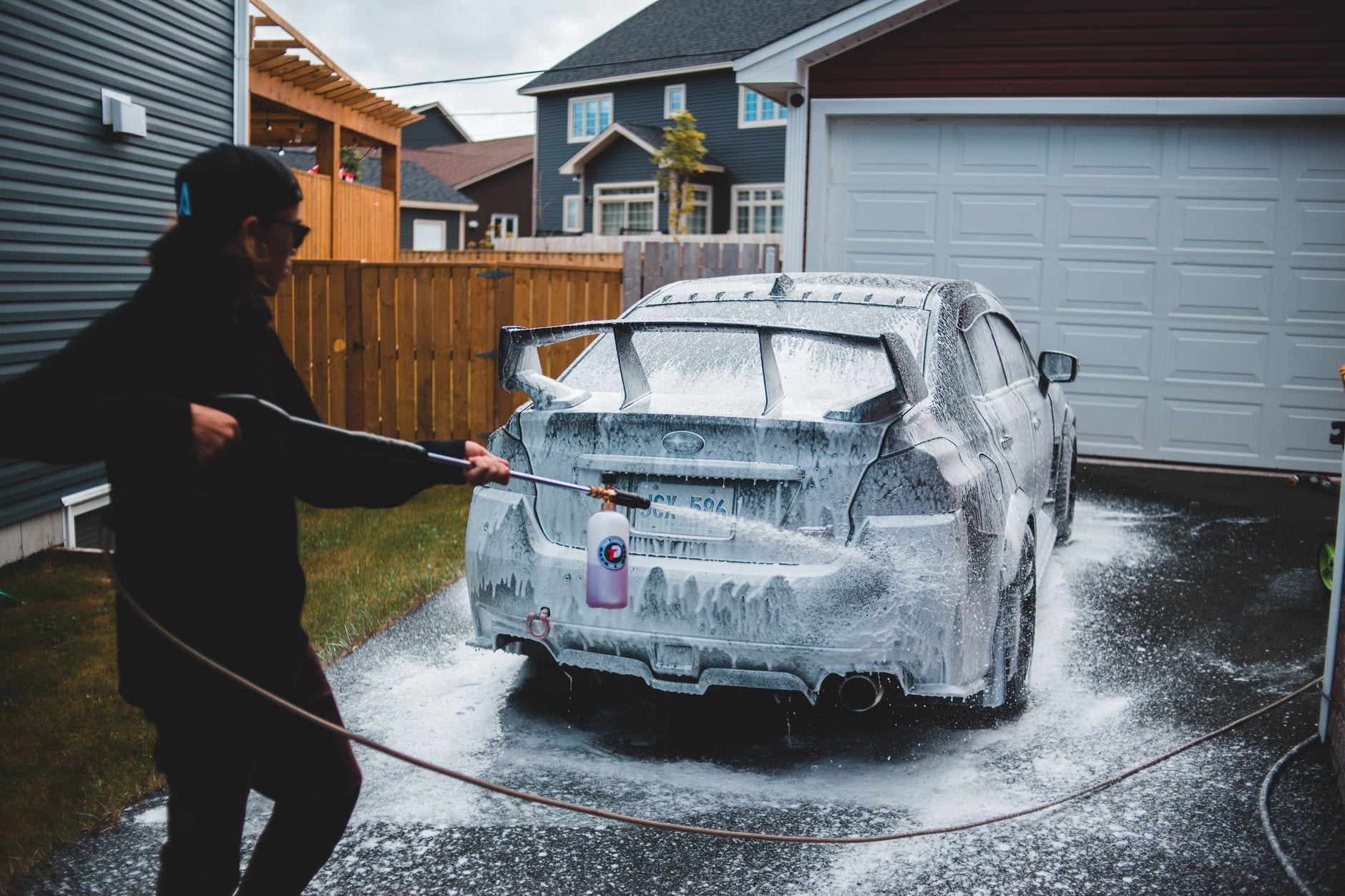
Concrete driveways, paths, kerbs, patios, pavers and garage floors. These take real pressure, and most of the work is done by a surface cleaner rather than a bare wand: a covered disc spinning two jets at a fixed height, so every square metre gets the same treatment and the slab dries even instead of striped.
What gets pre-treated. Oil and grease under a parked car, rust runs from a bore or a downpipe, and the black tannin staining you get where leaf litter has sat through a wet autumn. Each one takes a different product, and each one needs its dwell time before any water touches it.
What it will and will not fix. It takes off the grey film, the algae and most of the staining. Oil that has been soaking in for years lifts a long way and often leaves a shadow. A crack or a spalled patch is still a crack afterwards, only cleaner. Ask for a test patch on the worst area before the whole drive is priced.
What ruins it. A bare wand held too close on a steep angle. It cuts lines into the surface itself, and every one of them shows up once the slab dries out.
Local conditions
What a Sydney address changes about a wash
Salt air closer to the coast
Along the coast the film on a wall is salt as well as mould, and salt does not come off in one pass. Those walls want the cleaner left on longer and the rinse carried well past the point where the render looks clean.
Humidity, shade and regrowth
The black green film on a shaded path is algae and it is alive. Water knocks it off and leaves the spores in the pores, so it is back with the first wet fortnight. A south facing path under a tree comes back fastest.
Sandstone and older properties
Sydney sandstone is soft and porous, and on plenty of older homes it is a heritage item. High pressure strips the weathered face off it and nothing puts that back, so sandstone gets treated and rinsed rather than cut.
Terraces and semis
A shared wall, a side path a metre wide and no vehicle access decide how the gear gets in and where the run-off can go. That is worked out before the quote, not on the morning.
Strata blocks
Common property, a tap the building will let you draw from, notice to residents, and cars that have to be moved out of the car park first. A strata clean is quoted with that lead time in it.
Where the water ends up
Run-off carrying oil, paint or food waste is trade waste and it does not belong in a stormwater grate. On a house it is usually put to a garden bed or a sewer point instead, and that is sorted before the machine starts.
How these surfaces come up

Questions worth asking before you book a wash
The ones that decide whether the job comes up well, and whether anything gets damaged getting there.
Get your pressure cleaning quote
Tell us roughly how big the area is, what it is made of, and what is on it. A driveway with oil under the car, a rendered wall going green on the shaded side, a car park before a lease inspection. That is enough to quote from.